Documentation Index
Fetch the complete documentation index at: https://utexo-e7ed9bd0-feat-faucet-bot.mintlify.app/llms.txt
Use this file to discover all available pages before exploring further.
How It Works
The Bridge is composed of modular, stateless components that together coordinate a fully atomic transfer:| Component | Role |
|---|---|
| Bridge orchestrator | Tracks all in-flight transfers, routes events between connectors, and drives transfers to completion or cancellation |
| Connectors | Chain-specific gRPC services that monitor smart contracts for FundsIn events and issue FundsOut transactions on the destination chain |
| Federated Signer Nodes | A set of three independent listener nodes, each running inside an AWS Nitro Enclave, that jointly sign transactions using a 2-of-3 threshold scheme |
| Enclave Signer | Cryptographic microservice running inside an AWS Nitro Enclave; derives and holds private keys in a Trusted Execution Environment (TEE) so they never leave the hardware boundary |
| RGB Multisig Bridge | Multi-party custody layer for RGB assets, coordinated through a dedicated hub with a 2-of-3 cosigner threshold for both colored and vanilla UTXO outputs |
| BTC Relay | Lightweight Bitcoin header relay service that feeds block headers into the TEE for in-enclave SPV verification |
| REST Gateway | Public API used by the web UI and external integrations |
Bridge Orchestrator
The Bridge orchestrator is the central coordinator. It tracks all in-flight transfers in a persistent database, processesFundsIn events reported by Connectors, and instructs the appropriate destination Connector to issue a FundsOut transaction. If a transfer cannot be completed, the orchestrator drives it to safe cancellation.
Connectors
Each supported chain has a dedicated Connector — a stateless gRPC service that watches the chain forFundsIn smart contract events and issues FundsOut transactions on the destination chain. Connectors do not hold keys or funds. All signing is delegated to the Federated Signer Nodes.
Federated Signer Nodes
Transaction signing is distributed across three independent listener nodes, each running inside its own AWS Nitro Enclave. A valid signature requires agreement from at least 2 of the 3 nodes (2-of-3 threshold). No single node — and no external party — can unilaterally produce a valid signature. Key properties:- Threshold signing. All EVM (EIP-712) and Bitcoin (PSBT Taproot Schnorr) signatures require a 2-of-3 quorum across independent TEE instances.
- Keys never leave the TEE. BIP-39 key generation and all signing operations happen inside each enclave, with no persistent storage or shell access.
- In-enclave RGB validation. Every RGB consignment is validated inside the enclave before signing, cross-checking amounts against calldata and commission.
- In-enclave SPV verification. Bitcoin block headers are relayed into the TEE via the BTC Relay service, enabling the enclave to independently verify transaction inclusion without trusting any external data source.
- Memory safety. Secrets are zeroized on drop; the codebase enforces
#![deny(unsafe_code)].
Enclave Signer
The Enclave Signer (utexo-bridge-enclave-signer) is the base cryptographic microservice from which each Federated Signer Node is derived. It runs inside an AWS Nitro Enclave — an isolated compute environment with no persistent storage, no shell access, and network access limited to a vsock proxy allowlisted to an Esplora indexer and the BTC Relay.
RGB Multisig Bridge
The RGB Multisig Bridge coordinates multi-party custody of RGB assets across three cosigner nodes, using a 2-of-3 threshold for both colored (RGB) and vanilla UTXO outputs. It operates through a dedicated coordination hub and is independent of the Federated Signer Nodes, providing a separate trust boundary for RGB asset issuance and redemption.BTC Relay
The BTC Relay (btc-relayer) streams Bitcoin block headers to the Federated Signer Nodes. Inside each enclave, headers are validated against a hardcoded checkpoint block and the signet challenge script — both baked in at compile time and bound to the enclave’s PCR0 attestation measurement. This allows the TEE to perform SPV proofs without relying on any external indexer for header data.
Transfer Flow
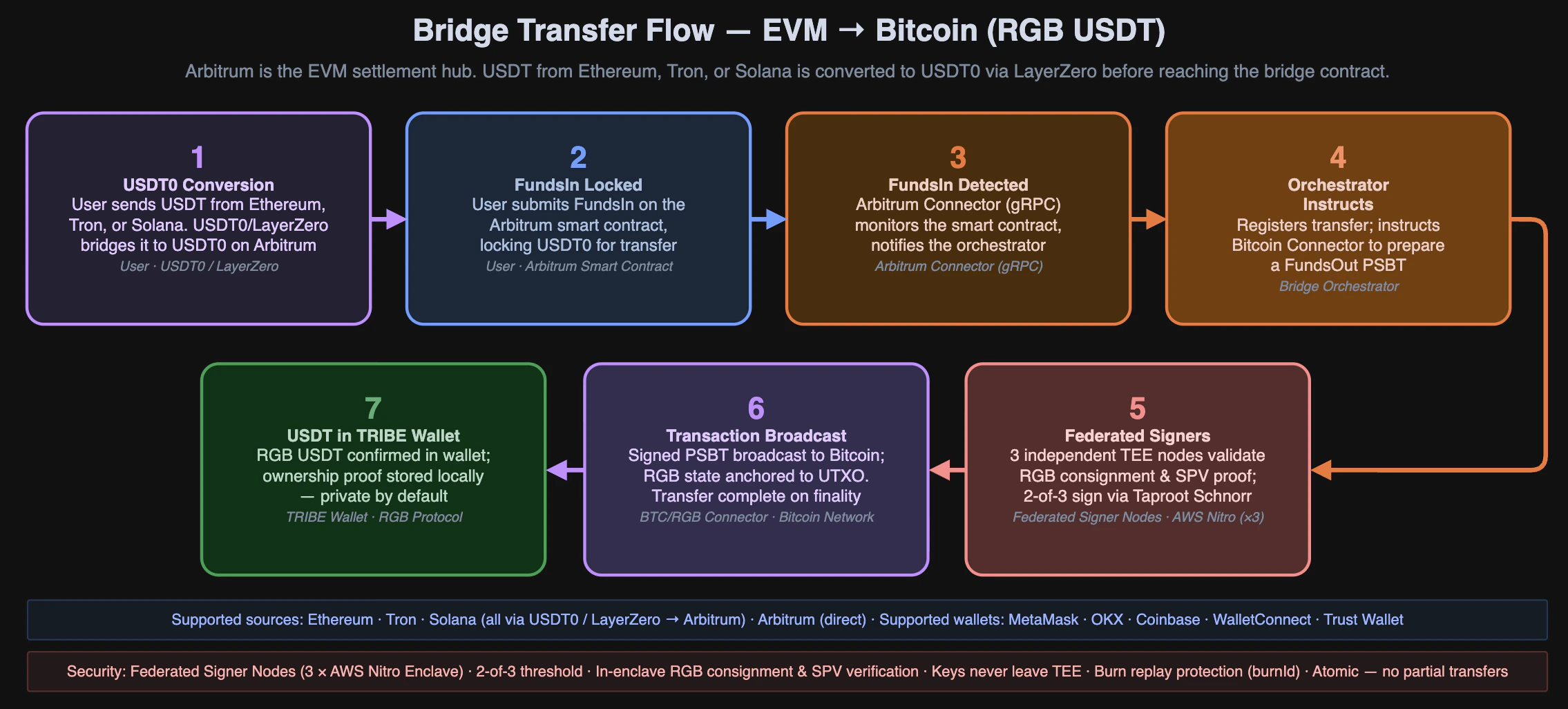
The following steps describe a complete atomic transfer:- User deposits funds on the source chain (
FundsIn). - The source Connector detects the on-chain event and notifies the Bridge orchestrator.
- The Bridge orchestrator instructs the destination Connector to release funds (
FundsOut). - The Federated Signer Nodes sign the
FundsOuttransaction inside their respective TEEs; a 2-of-3 quorum is required before broadcast. - Transfer is marked complete once finality is confirmed.
- User submits a USDT transfer from their Ethereum wallet. The USDT0 / LayerZero protocol bridges it to USDT0 on Arbitrum transparently.
- User submits a
FundsIntransaction on the Arbitrum smart contract, locking USDT0. - The Arbitrum Connector detects the event and notifies the orchestrator.
- The orchestrator instructs the Bitcoin Connector to prepare a
FundsOutPSBT. - The Federated Signer Nodes validate the RGB consignment and SPV proof inside their enclaves; 2 of 3 sign the PSBT using Taproot Schnorr.
- The signed transaction is broadcast to Bitcoin. Once confirmed, USDT appears in the user’s RGB wallet.
Supported Networks
| Network | Type | Direction |
|---|---|---|
| Arbitrum | EVM (secp256k1) | Inbound & Outbound |
| Bitcoin (RGB layer) | Taproot / Schnorr | Inbound & Outbound |
Supported Assets
| Asset | Source Network | Representation on Bitcoin |
|---|---|---|
| USDT | Ethereum, Tron, Solana (via USDT0) | RGB USDT |
| USDT0 | Arbitrum | RGB USDT |
Fees
Commissions are managed on-chain through theCommissionManager contract. For token transfers (USDT, USDT0), fees can be applied on both FundsIn and FundsOut. For native currency, fees are only taken on FundsIn — charging on FundsOut is not applicable since that leg is triggered by the protocol rather than the user. The current fee rate is 0.4% across supported networks.
Security
Signing authority is distributed across three independent Federated Signer Nodes, each running inside its own AWS Nitro Enclave. No single node can produce a valid signature unilaterally — a 2-of-3 threshold is required for every EVM and Bitcoin transaction. This eliminates single-point-of-failure risks for key compromise, infrastructure access, and operator collusion. The Esplora indexer connection via vsock proxy is the only network interface allowed from within each enclave for RGB consignment validation. Bitcoin header data arrives via the BTC Relay, which feeds headers for in-enclave SPV verification against a compile-time checkpoint — limiting the attack surface to a small, auditable set of read-only data sources. Burn replay protection. The TEE extracts aburnId from each RGB consignment before signing. This identifier is passed as a FundsOut parameter and stored by the smart contract, which rejects any FundsOut call reusing a previously seen burnId.
Public attestation. The enclave binary is reproducibly buildable, and each node publishes a verifiable attestation binding its public key to the PCR0 measurement of the deployed code. A VERIFY.md document provides step-by-step guidance for independently confirming that the keys held inside the EVM smart contract were generated and remain inside a genuine Nitro Enclave.
Guide
Getting Started
Transfer USDT between Ethereum and the Bitcoin RGB layer.